
Table of Contents
ToggleThe choice between Circular Knitting and Flat Knitting in the 2026 textile world is no longer just a technical preference. Instead, it has become a strategic decision that dictates a brand’s speed to market, design complexity, and sustainability footprint.
The fashion industry in the age of high technology is pivoting toward ‘Software-Defined Fashion’ and 3D Garment Construction.
Both Circular Knitting and Flat Knit create fabric by interlocking loops of yarn. However, they occupy entirely different ends of the manufacturing spectrum.
All About Circular Knitting
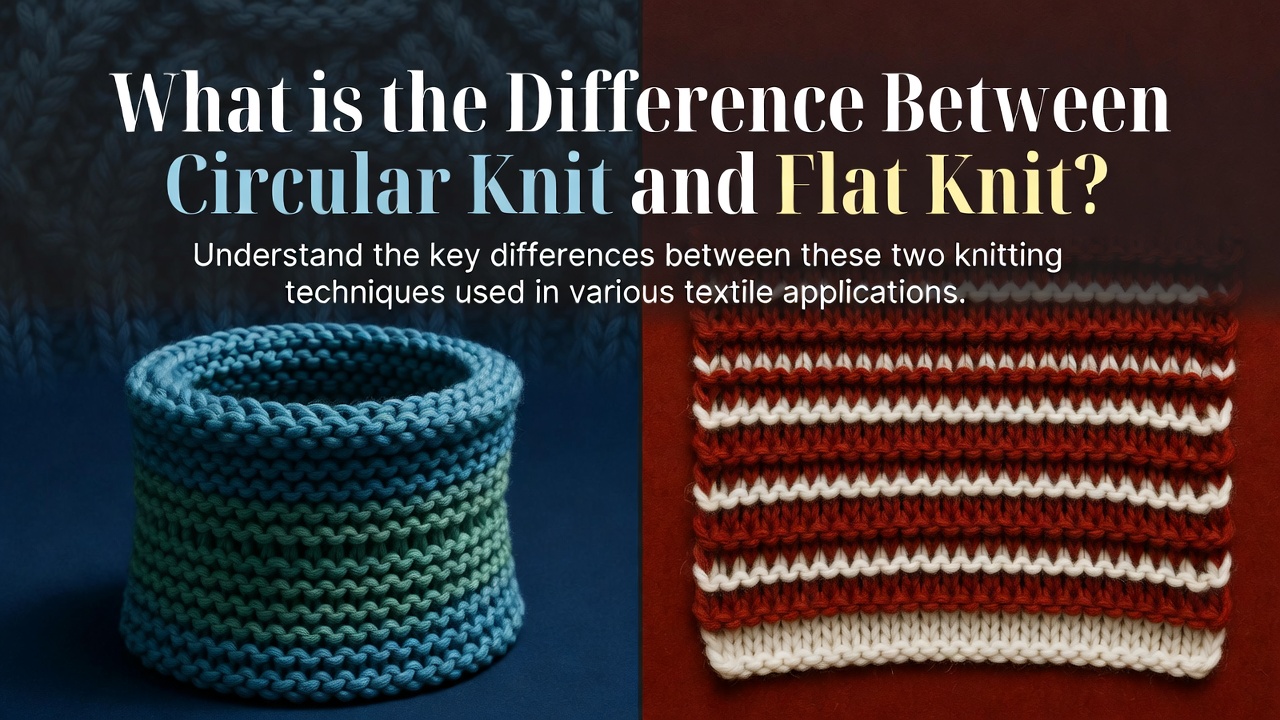
Circular Knitting is defined as the powerhouse of mass production. It involves knitting in a continual spiral to create a seamless tube of fabric.
A person is more likely if wearing a standard T-Shirt, Leggings, or Socks, to be donning the product of a Circular Knitting Machine.
How Does It Work?
A Circular Machine features
- Needles arranged in a large cylinder.
- Multiple yarn feeds (at times up to 100+) supply yarn to the needles. At the same time, it can produce fabric at extreme high speeds.
Main Characteristics of Circular Knit
- FABRIC SHAPE: Always produced as a Tube. The tube for wide-width fabrics like those used for bedding is slit vertically, creating a flat sheet.
- PRODUCTION SPEED: Extremely high. It is the gold standard for high-volume, low-cost (‘cut-and-sew’) garments.
- TEXTURE: Results typically in lighter, smoother, and more elastic fabrics. Like for instance, single jersey, rib, or interlock.
- LIMITATION: Prone to ‘spirality’. That is a slight diagonal twist in the fabric drain caused by the continual spiral motion. This can lead to twisted seams after washing.
All About Flat Knitting
An artisan’s choice for structure and detail, Flat Knit is a highly sophisticated textile technique. Its durability and precision gives it a superior edge.
A flat knitting machine unlike circular knitting continuous loop works back and forth across a straight needle bed, identical to the movement of a manual hand-knitter.
This method creates a stable, high-density fabric. The fabric holds its form and simultaneously, provides exceptional breathability.
How Does It Work?
- Needles are set in one or two flat beds. They are often set in a ‘V’ shape.
- Carriage moves horizontally across these beds. They lay the yarn and form the stitches.
Modern computerized flat knitting machines are essentially 3D printers for yarn.
Main Characteristics of Flat Knit
- FABRIC SHAPE: Produced as Flat Panels or ‘Fully Fashioned’ pieces. The shape of a sleeve of sweater front is knitted directly.
- DESIGN VERSATILITY: Unmatched. It can produce intricate cables, 3D textures, intarsia patterns, and complex jacquards.
- THICKNESS: Used for heavier, more structured items. Like for instance, sweaters, cardigans, collars, and high-end knitwear.
- SUSTAINABILITY: Can knit garments to shape. This produces significantly less textile waste (zero-waste knitting). Cutting shapes out of large circular fabric rolls on other hand produces considerable waste.
Comparison: Circular vs Flat Knit
| FEATURE | CIRCULAR KNITTING | FLAT KNITTING |
| Machine Type | Circular Knitting Machine (Cylindrical) | Flat Knitting Machine (Straight/V-Bed). |
| Output Shape | Seamless Tubes (Tubular) | Flat Panels Or 3D Shapes. |
| Best For | T-Shirts, Underwear, Activewear, Socks | Sweaters, Cardigans, Collars, Knit Shoes. |
| Speed | Extremely Fast (Mass Market) | Slower (Bespoke / High-End). |
| Waste Level | High Due To ‘Cut-And-Sew’ | Low (Fully Fashioned, Zero-Waste). |
| Pattern Detail | Limited To Overall Textures / Prints | Infinite (Cables, 3D Structures, Intarsia). |
The lines between these two technologies by 2026 will blur more thanks to ‘hybrid’ manufacturing.
- CIRCULAR SEAMLESS TECHNOLOGY: Circular machines today are more than capable of varying the stitch tension. They create body-mapped compression in activewear. These mimic the shape of flat knitting. At the same time, maintain circular speeds.
- 3D KNITTING (WHOLESALE GARMENT): Flat knitting machines can now knit at one piece an entire sweater. This includes sleeves and all, thereby eliminating the need for a sewing room entirely.
- THE SUSTAINABILITY MANDATE: Brands are increasingly choosing Flat Knit for high-end collections. That’s because ‘Fully Fashioned’ reduces fabric scrap waste by up to 30 percent. This is critical metric for ESG reporting.
Which is Better Choice for Your Product?
Opt for Circular Knitting if:
- You are producing high-volume basics. That is, 1,000 + units) where fabric softness and cost-per-unit are the main goals.
Opt for Flat Knit if:
- You are creating a ‘hero’ piece with unique textures; 3D elements; or a premium tailored fit that needs minimal sewing.
Conclusion
Circular Knitting is termed as the ‘engine’ of the global wardrobe. It provides the affordability and comfort that people expect from daily essentials.
Flat Knit on the other hand is termed as the ‘architect’ of the wardrobe. It provides the structure, intricate beauty, and sustainability found in designer pieces.
A successful brand in the 2026 market will rarely pick only one choice. They opt for circular knits for the base and flat knits for the statement. By enlisting the expertise of Knit N Sew, textile companies can enhance their productivity and market reach.
FAQs
1. Which is more suitable for mass production?
Circular Knitting is significantly faster. It moves in one direction without halting to change rows. A circular machine can also produce large volumes of fabric, like jersey for T-Shirts. It can do so at a fraction of the time that a flatbed machine takes. This makes it the standard for bulk manufacturing.
2. Can a sweater on a Circular Knitting Machine be knitted?
Yes. However, it needs to be done with limitations. Circular machines are often used for lightweight, seamless sweaters. Else they are used for producing the raw ‘tubular’ fabric that’s later cut and sewn into a sweater.
A flatbed knitting machine is how preferred for structured sweaters with intricate cables, textures, or specific shaping (like a tailored shoulder).
3. Why is ‘Flat Knit’ regarded as more sustainable?
It supports ‘Fully Fashioned’ production. The machine knits each piece (front, back, sleeves) to the exact shape required. This results in almost zero fabric waste.
Circular knitting produces large rolls of fabric that needs to be cut into shapes. They leave behind significant textile scraps.
4. Are Flat Knitting Machines more suitable for complex designs?
A. Yes. Modern computerized Flat Knitting Machines offer unmatched design flexibility. They can execute Complex Intarsia, Jacquard, and 3D Textures like Honeycomb or Cables that are impossible or difficult to achieve on a standard circular machine.
5. Which among the two knitting styles is more comfortable for activewear?
Circular Knitting is typically favored. It is favored for activewear and base layers. Its ability to produce seamless tubes reduces the need for bulky side seams. This can otherwise cause chafing during movement.