
Table of Contents
ToggleMost textile factory owners we’ve spoken to in Ludhiana say the same thing: machines that worked fine five years ago are now costing them money. Not because they broke down, but because they can’t keep up. Orders are tighter, margins thinner, and buyers who once gave two weeks now want delivery in five days.
If your production floor still runs on older equipment, you’re not just behind schedule. You’re behind the market.
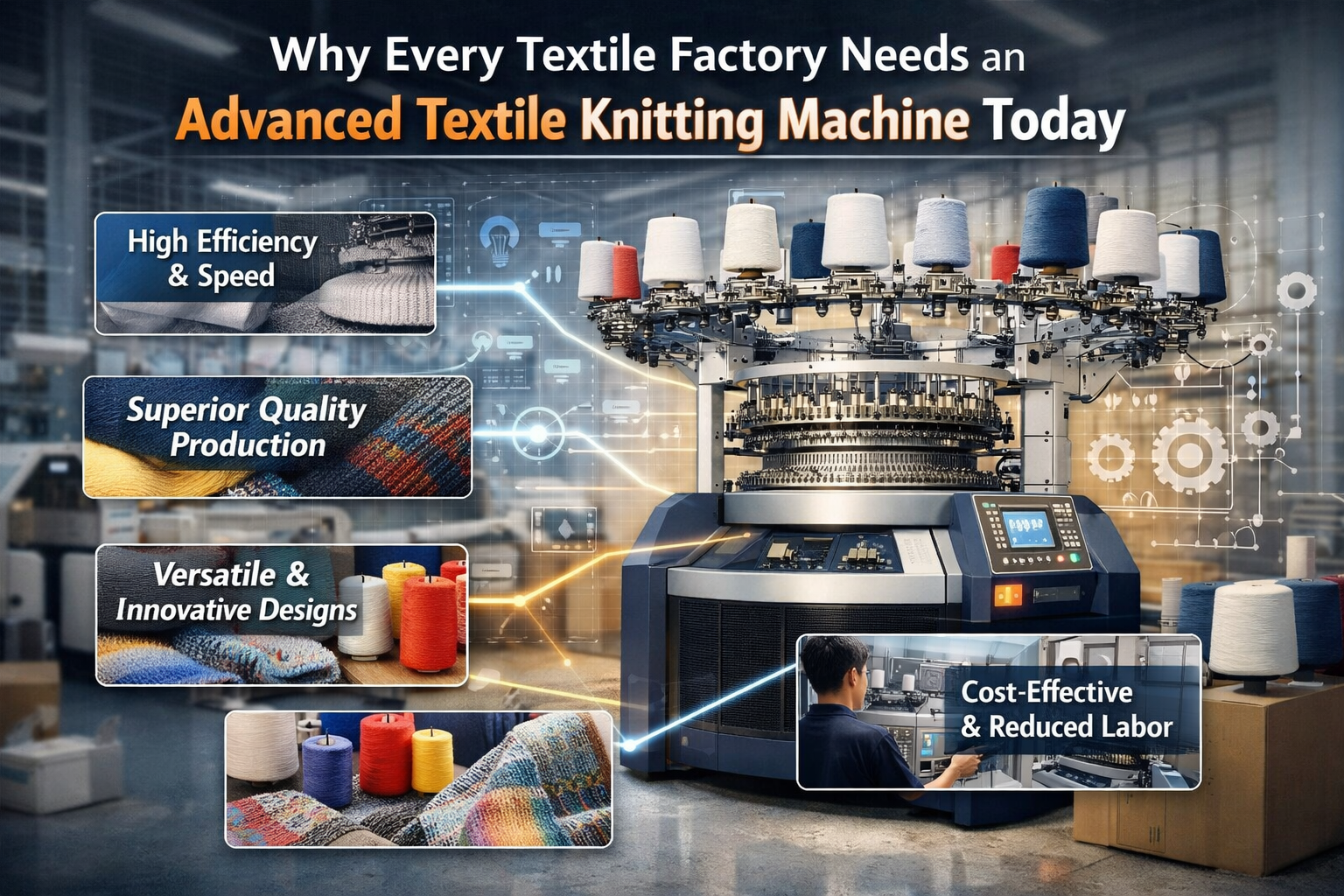
Why every textile factory needs an advanced textile knitting machine today
Fabric buyers want smaller batches, faster turnarounds, and consistent quality across every roll. A textile knitting machine built for 2015 volumes simply cannot handle 2026 demands without creating bottlenecks.
Fast fashion cycles have shortened from months to weeks. Export clients run third-party audits that flag even small variations in GSM or loop density. Your workforce has shrunk because skilled operators are hard to find. An advanced knitting machine absorbs that pressure by automating tasks that used to depend entirely on a senior operator’s instinct and eye.
How does a modern textile knitting machine change daily output?
A modern circular textile knitting machine running at 25 to 30 RPM with 90+ feeders produces 350 to 500 kg of single jersey fabric per day. Older models manage 180 to 250 kg. That is double the output from the same floor space and operator count.
But speed is only part of the story. With older equipment, you lose 8 to 12 percent of production to defects like dropped stitches, oil stains, and uneven tension. A well-maintained advanced knitting machine brings rejection down to 2 or 3 percent. Over a month, that difference alone pays for the upgrade.
How does needle precision affect fabric quality in a textile knitting machine?
Older machines use standard latch needles that wear unevenly. After a few months, certain cylinder sections produce tighter loops than others, showing up as horizontal lines or shade variation after dyeing.
Modern machines use precision-ground needles with tighter tolerances. Some models let you swap needle types without retiming the entire machine, so you can switch between cotton, polyester, and blended yarns within the same shift. For a textile factory handling multiple fabric types, this flexibility removes hours of changeover time.
Energy savings: what it actually costs to run a knitting machine
An older 30-inch circular knitting machine consumes 5 to 7 kW per hour. A newer model of similar diameter uses 3.5 to 5 kW at higher RPM. Multiply that gap by 8,000 running hours a year, and you’re looking at savings of Rs 2 to 4 lakhs annually, depending on your state electricity tariff.
For textile factory operators in Punjab and Tamil Nadu, where power costs have risen 15 to 20 percent in three years, this is a real number that affects annual margins.
What to look for when buying a textile knitting machine?
Gauge and diameter: matching the knitting machine to your fabric type
A 24-gauge machine handles fine fabrics for T-shirts and innerwear. A 14 or 18-gauge suits thicker rib or interlock fabrics. Diameter affects roll width: 30-inch is standard for garment panels, while 34 or 36-inch works better for bedsheet fabrics. Get it wrong, and you waste material or lose orders.
Spare parts and service: the hidden cost of the wrong knitting machine
A machine is only as reliable as the supply chain behind it. If your knitting machine uses proprietary needles that take three weeks to import, every breakdown becomes a production crisis. Machines from manufacturers with local dealer networks in Ludhiana give you needles, sinkers, and cams within a day or two. That is the difference between a one-shift disruption and a week-long shutdown.
The real cost of outdated equipment in a textile factory
If you’re losing 10 percent of production to quality issues and your monthly output is worth Rs 25 lakhs, that is Rs 2.5 lakhs in wasted fabric every month. Over a year, it crosses Rs 30 lakhs.
Delivery delays cost clients. Export buyers penalize late shipments, and some cancel outright. Miss two or three deadlines, and that client goes to your competitor next season.
Labour cost is another factor nobody tracks properly. Older machines need experienced operators who manually adjust tension and catch defects by sight. Newer machines with automatic tension control let less experienced operators run two machines at once with fewer errors. Your per-machine labour cost drops almost in half.
Add it all up, and most textile factory owners find their “fully paid off” old machine costs them Rs 40 to 60 lakhs a year in hidden losses.
Choosing between new and used textile knitting machines
Budget matters. Not every operation can invest Rs 15 to 25 lakhs upfront. Used knitting machines from a reliable dealer can deliver 70 to 80 percent of new machine performance at 40 to 50 percent of the cost.
What matters is who you’re buying from. A good dealer will have already replaced or reground the needles, recalibrated the yarn feeders, and run the machine under load before showing it to you. Ask about the motor condition and whether they offer at least 3 to 6 months of warranty on parts. If they hesitate on any of that, you’re better off looking elsewhere.
FAQs
What types of fabric can a textile knitting machine produce?
Single jersey, rib, interlock, pique, fleece, terry, and mesh fabrics. The specific output depends on gauge, cam arrangement, and feeder setup.
How often does a knitting machine need maintenance?
Daily cleaning and oiling are necessary. Full service, including needle replacement and cam inspection, should happen every 3 to 6 months based on running hours.
Can a small textile factory benefit from an advanced knitting machine?
A two or three-machine setup with modern equipment can outperform a larger unit running five or six older machines, thanks to higher output per hour and lower fabric wastage.
Get in touch with Knit N Sew Enterprises
If your current equipment is holding your textile factory back, talk to the team at Knit N Sew Enterprises. They’ve been operating out of Ludhiana since 1998, so they know the local market and the kind of machines that actually hold up on Indian production floors. They deal in new and used circular knitting machines, stock needles and sinkers, and carry spare parts for the most common models. More importantly, they can tell you what your factory actually needs instead of just selling you the most expensive option.