
Table of Contents
ToggleIf you’ve ever looked at a patterned fabric and wondered how those precise designs get woven into cloth, the answer almost always traces back to one invention: the Jacquard machine. This technology, originally developed in the early 1800s, didn’t just change weaving. It changed how we think about automated production altogether. And for anyone running a textile unit today, understanding the jacquard knitting machine isn’t optional. It’s the difference between producing basic plain fabrics and creating the high-value patterns buyers actually want.
How the Jacquard machine became the backbone of pattern weaving
Before Joseph Marie Jacquard introduced his punch-card system in 1804, creating patterned fabric was painfully slow. A weaver would manually lift individual warp threads to form each row of a design. Complex patterns could take weeks, errors were common, and scaling up was practically impossible.
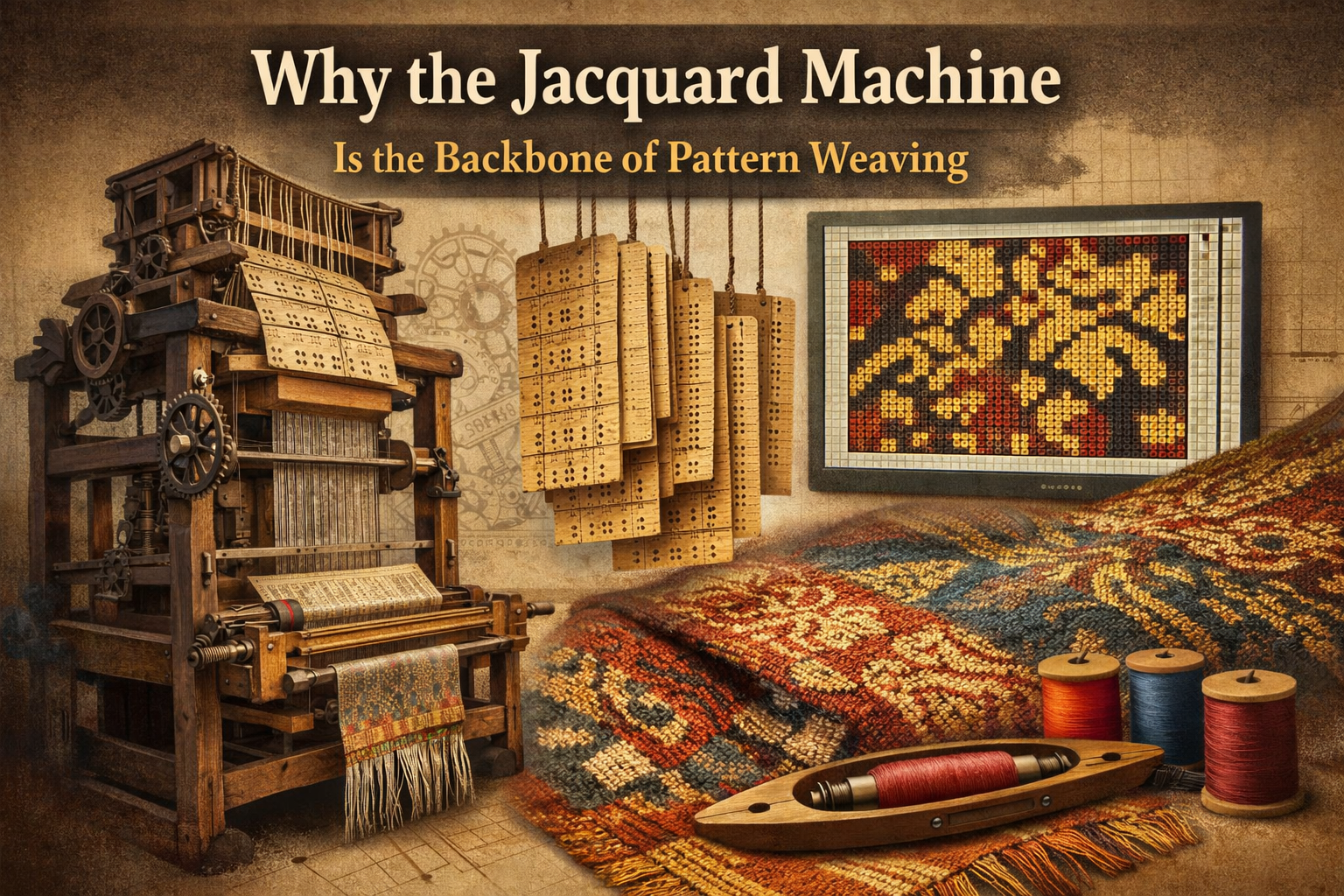
The Jacquard machine replaced that manual thread selection with punched cards. Each card told the loom which threads to raise and lower for a given row. String enough cards together, and you could program an entire pattern without the weaver thinking about individual threads. That was a genuine turning point. The Jacquard machine made patterns that were previously impossible into something any well-equipped workshop could produce.
What a jacquard knitting machine actually does
The principles behind Jacquard’s 1804 invention still run through modern pattern weaving. The technology has evolved from punch cards to electronic controls, but the core idea remains the same. Each needle gets individual instructions about when to engage and when to stay put.
A modern jacquard knitting machine controls each needle independently. Every stitch can be a different color or texture if the design calls for it. Compare that to a standard circular knitting machine, where all needles follow the same pattern repeatedly. The jacquard knitting machine breaks that limitation entirely. This individual needle control is precisely why the Jacquard machine is the backbone of pattern weaving.
Why the Jacquard machine is the backbone of pattern weaving in today’s market
Demand for patterned and customized fabrics has grown sharply. Sportswear brands want unique knit textures. Fashion labels want custom jacquard fabrics. Even home textiles have moved toward detailed patterns on curtains and upholstery. All of this runs on jacquard technology.
The jacquard knitting machine on circular production lines
On a modern electronic jacquard knitting machine, you upload a new design file and the machine reads it. A factory can run three different designs in a single shift without major downtime. Modern jacquard systems control thousands of needles simultaneously while running at high RPM, producing clean, consistent patterns roll after roll. There’s less yarn waste too, because each needle is individually controlled during color changes and transitions. For manufacturers working with expensive yarns like merino blends, the savings add up quickly.
The backbone of pattern weaving: from loom to knitting floor
The term “jacquard” has expanded well beyond its original weaving context. Today, the jacquard knitting machine applies individual needle control to knitted fabrics, not just woven ones. Knitted fabrics have different stretch, drape, and texture characteristics. A jacquard-knitted sportswear fabric can have breathability zones built right into the pattern. The backbone of pattern weaving, then, isn’t confined to one type of production. Jacquard technology has become the common thread running through woven, knitted, and technical textile manufacturing. That’s a big part of Why the Jacquard Machine Is the Backbone of Pattern Weaving, even in factories that primarily run circular setups.
What to look for in a jacquard knitting machine
Choosing the right jacquard knitting machine for your factory
Electronic control has largely replaced mechanical jacquard systems, and for good reason. Electronic offers faster pattern changes and more design complexity. Match your gauge to what your market actually demands, not what looks impressive on a spec sheet. Check compatibility with your existing circular knitting machines before you invest, since some jacquard systems need dedicated frames.
Software matters more than most buyers expect. The best jacquard knitting machine is only as good as the design software feeding it. And don’t underestimate after-sales service. Jacquard systems are more complex than standard machines, so you’ll need a supplier who provides spare parts, troubleshooting, and training.
The backbone of pattern weaving is also the bridge to better margins
Plain fabrics are commodities. Margins stay thin because you’re always competing on price. Patterned and specialty fabrics are a different story. Fewer manufacturers can produce them, so buyers pay more. A jacquard knitting machine lets you move up the value chain without tearing apart your existing operations. We’ve seen manufacturers recoup the cost of their jacquard investment faster than expected, simply because patterned fabrics sell for significantly more per meter.
Partner with Knit N Sew for your jacquard knitting machine needs
Whether you’re upgrading an existing circular knitting line or setting up a new unit from scratch, having the right machinery partner matters. At Knit N Sew, we’ve been supplying textile manufacturers in Ludhiana and across India with circular knitting machines, needles, and spare parts since 1998. Our team understands the practical demands of a knitting floor, and we work closely with our clients to match them with the right equipment for their production needs and budget. Reach out to us at clonit.co.in or call us directly to request a quote.
FAQs
What is a jacquard knitting machine?
A jacquard knitting machine controls each needle independently, allowing it to produce complex, multi-color patterns in fabric. It applies the same principles Jacquard introduced for weaving looms in 1804, adapted for modern knitting production.
How is a jacquard knitting machine different from a regular knitting machine?
A regular knitting machine moves all needles in the same pattern repeat. A jacquard knitting machine controls each needle separately, so every stitch in the fabric can be different.
Why is the Jacquard machine called the backbone of pattern weaving?
The Jacquard machine introduced individually controlling threads and needles using programmed instructions. This concept remains the foundation of all patterned fabric production today, whether woven or knitted.
Can a jacquard knitting machine work with circular knitting setups?
Yes. Jacquard systems are available as attachments for circular knitting machines or as dedicated jacquard circular machines that combine high-speed tubular production with pattern control.
Where can we get reliable jacquard and circular knitting machines in India?
Knit N Sew, based in Ludhiana, offers circular knitting machines, spare parts, needles, and technical support for textile manufacturers. Visit clonit.co.in to learn more or request a quote.