
Table of Contents
ToggleIf you run a textile unit in India, you already know plain fabrics don’t sell the way they used to. Buyers want texture, colour combinations, and designs that stand out. And if you’ve been chasing those results with older cam-driven setups, you’ve probably felt the gap between what your machines can do and what the market demands.
That gap is where sinker jacquard technology steps in. Over the past few years, these systems have quietly changed how manufacturers in Ludhiana, Tiruppur, and Surat approach patterned knit fabrics, and the results speak for themselves.
How a Jacquard Knitting Machine Creates Patterns
A jacquard knitting machine uses individual needle selection to create patterns during the knitting process itself. Each needle can be independently controlled to knit, tuck, or miss a stitch, so you can program anything from simple stripes to complex multi-colour motifs without swapping mechanical parts.
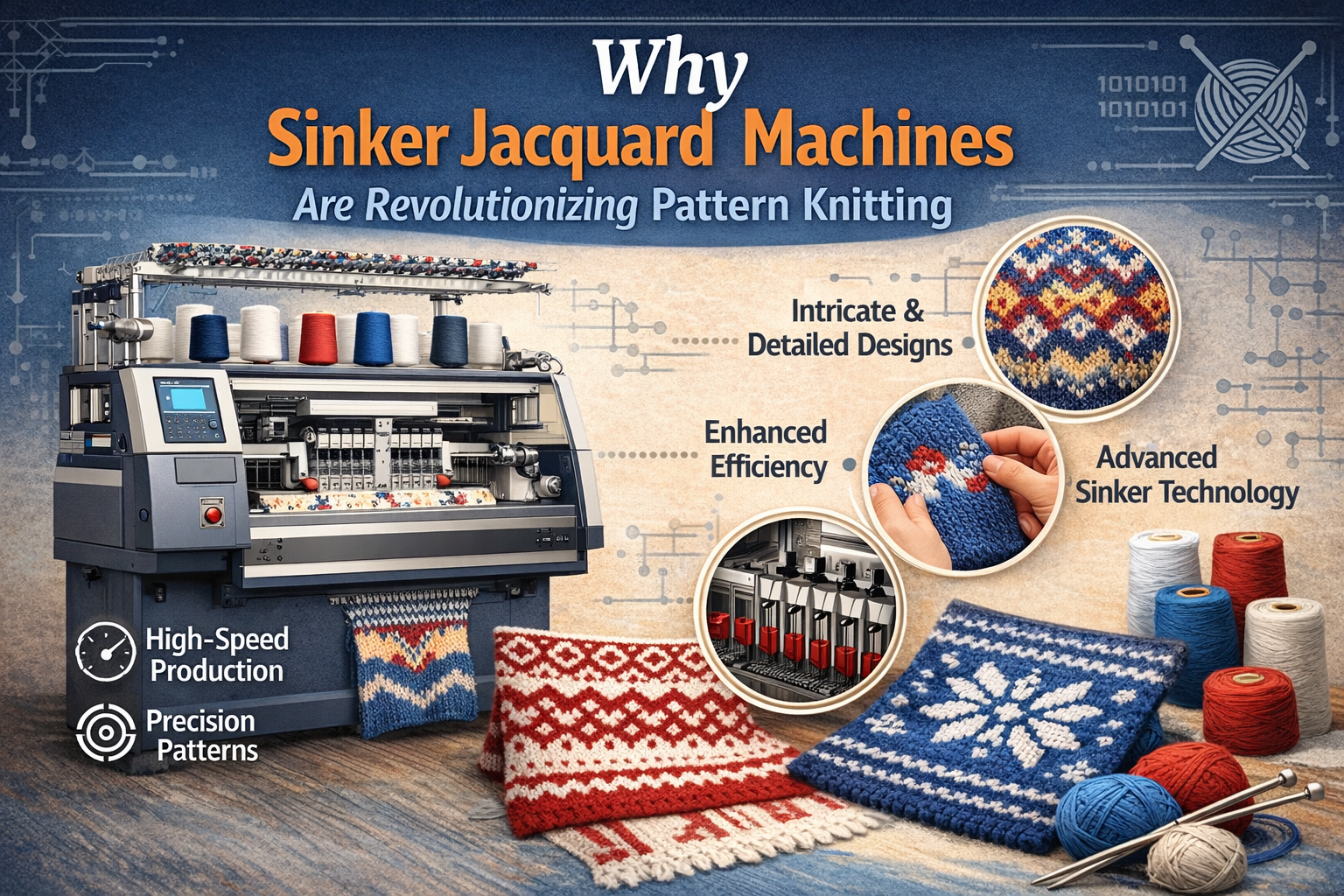
In sinker jacquard systems, the sinker (a thin metal plate between adjacent needles) does more than hold fabric down while needles rise. It actively controls loop formation and stitch tension. When each sinker is electronically controlled, you get stitch-by-stitch precision that fixed-cam systems can’t match. The practical result is sharper colour boundaries, fewer floats, and a noticeably cleaner fabric face.
On a standard machine, sinkers follow a fixed path. They all move the same way at the same time, which is fine for plain single jersey but becomes a bottleneck the moment you need pattern variation within a single course. Electronic sinker selection removes that limitation entirely, and that is why sinker jacquard machines are revolutionizing pattern knitting across the Indian textile industry.
What Makes the Best Electronic Jacquard Worth the Investment
Not all electronic jacquard systems are built the same. Some manufacturers bolt a basic selector onto an older mechanical frame and call it “computerised.” Those machines usually run slower, break down more often, and limit your pattern repeat size.
The best electronic jacquard systems share a few traits. Selection speed keeps up with 25+ RPM. The software reads standard design formats like BMP or PAT files without proprietary conversion. And the hardware handles continuous production without overheating.
When you’re shopping for the best electronic jacquard, look beyond the brochure. Ask about pattern repeat capacity, colour-per-course limits, local spare parts availability, and 24-hour service support. In a market where downtime costs real money, those details matter more than any spec sheet.
Why the Circular Jacquard Knitting Machine Dominates Production
The circular jacquard knitting machine is the workhorse behind most patterned knit fabric produced globally. Running at 28 RPM with 72 feeders, a well-maintained circular jacquard knitting machine produces fabric at speeds flat-bed machines can’t touch. And because fabric comes off as a continuous tube, you skip the selvedge waste that plagues flat knitting.
Single jersey jacquard covers about 70 percent of Indian production needs, ideal for T-shirts, activewear, and innerwear. Double jersey jacquard, using both cylinder and dial, creates thicker reversible fabric for outerwear and technical textiles. That 30 percent of double jersey work is usually the higher-margin business.
Design changes on a computerised circular jacquard knitting machine take minutes instead of hours. Load a pattern file from USB, the machine maps it to needle positions, and you’re running the new design before your chai gets cold. Some systems even preview patterns on-screen so you catch errors before they become 200 metres of wasted fabric.
How a High Speed Electronic Jacquard Machine Pays for Itself
Speed is money in knitting. A high speed electronic jacquard machine uses piezo-electric or spring-return selectors that respond faster than older solenoid systems, maintaining 30+ RPM even on complex multi-colour patterns.
Here are rough numbers: upgrading from a mechanical jacquard at 18 RPM (about 120 kg per shift) to a high speed electronic jacquard machine at 30 RPM can push output to 190 or 200 kg per shift. That is 60 to 70 percent more fabric from the same floor space and the same operator. Factor in faster pattern changes and lower defect rates, and the payback period for most units falls between 18 and 30 months.
Speed does put more stress on parts. Sinkers and needles wear faster, and electronic selectors need periodic inspection. But a solid maintenance routine (daily oiling, weekly sinker checks, monthly electronics review) keeps a high speed electronic jacquard machine running smoothly for years.
Why Sinker Jacquard Machines Are Revolutionizing Pattern Knitting in India
Previous machine upgrades mostly improved speed or reduced labour. Sinker jacquard changes what you can actually make. Patterns that once required expensive imports can now be produced locally. Designs previously limited to slow flat-bed machines can be approximated on fast circular setups.
If you’re considering this upgrade, the machine is only half the equation. You need a supplier who understands the technology well enough to match the right configuration to your products.
That is what Knit N Sew has been doing since 1998. Based in Ludhiana, Knit N Sew supplies new and pre-owned circular knitting machines along with needles, sinkers, spare parts, and hands-on technical support. Whether you need a jacquard knitting machine for the first time or you’re upgrading from an older model, their team can match you with the right equipment. Reach them at (+91) 9814177799 or visit clonit.co.in.
Why Sinker Jacquard Machines Are Revolutionizing Pattern Knitting: FAQs
What is the difference between standard jacquard and sinker jacquard?
Standard jacquard controls only needles electronically while sinkers follow a fixed path. Sinker jacquard controls both needles and sinkers independently, producing sharper designs with fewer defects.
How much does a jacquard knitting machine cost in India?
New electronic models range from INR 15 lakh to INR 50 lakh depending on specs. Pre-owned machines cost less, and Knit N Sew offers both options.
What fabrics can a circular jacquard knitting machine produce?
These machines handle single jersey jacquard, double jersey jacquard, terry jacquard, interlock jacquard, and pique jacquard depending on configuration.
Is the best electronic jacquard worth the premium over mechanical?
For most manufacturers, yes. Faster pattern changes, lower defect rates, and the ability to take on higher-value orders make the best electronic jacquard a strong investment that typically pays back within two years.
How long does it take to operate a high speed electronic jacquard machine?
Experienced circular knitting operators pick up electronic jacquard basics in two to four weeks. Design software takes another week or two. Knit N Sew provides training with machine purchases.