
Table of Contents
ToggleManufacturing usually requires massive capital. At least that’s what people believe.
People assume they need acres of factory space and dozens of workers to make money in the apparel industry. That is false. There is a specific niche that works in a standard 10×10 room. Socks. Every person wears them. They wear out quickly. Retailers constantly need fresh stock. You can supply that demand directly from a small workspace.
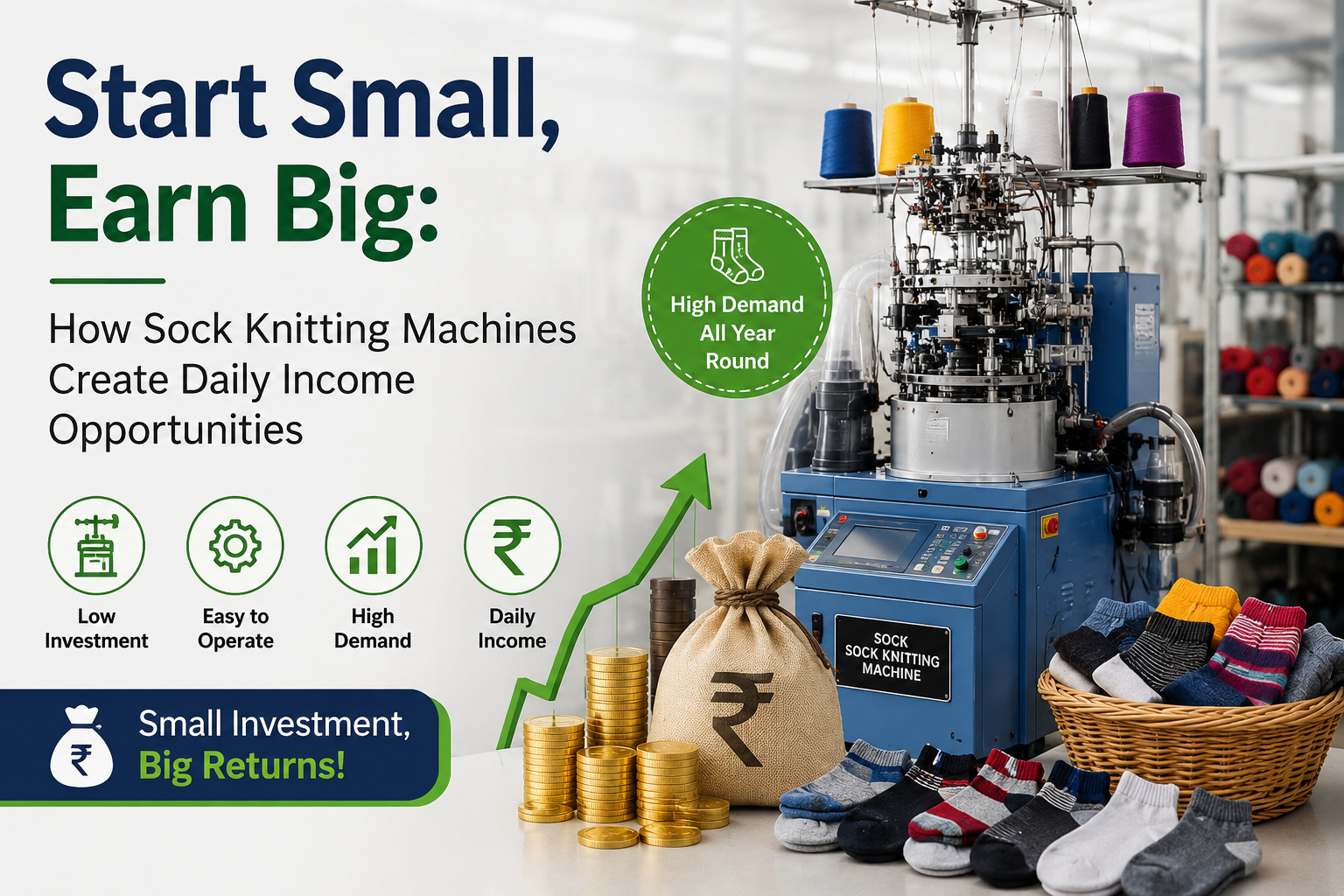
The Daily Economics of a Sock Knitting Machine
Let us look at the actual numbers. A standard setup produces dozens of pairs per hour. You buy yarn in bulk. You feed it into the equipment. The output is a finished product ready for packaging. Local markets pay cash for daily deliveries. This creates an immediate revenue cycle. You do not wait 90 days for payments. Shop owners buy inventory weekly.
Talk to wholesalers in your city. They move thousands of pairs a week. If you can supply fifty dozen pairs of consistent quality, they will buy from you. The margins are thin at the wholesale level. The volume makes up for it. Retail direct gives you better margins but requires more legwork on the streets.
Choosing the best sock knitting machine for small business operations changes how you manage overhead. You do not need five operators to start. One person manages multiple units. This keeps labor costs near zero during the initial phase. You turn it on. You watch the tension. You collect the finished pieces.
Why the Automatic Sock Knitting Machine Changes the Game
Older equipment required constant manual intervention. A thread breaks and production stops. You lose an hour fixing it. An automatic sock knitting machine handles tension control and pattern switching without you touching the dials. You load the digital file. The equipment reads it and starts working.
We see operators running these units from their garages successfully. They program a school uniform pattern on Monday. On Wednesday they switch to ankle socks for retail shops. It takes five minutes to change the production run. The versatility is what keeps the cash flowing. If one product stops selling, you immediately manufacture something else.
Operating a Computerized Sock Knitting Machine at Home
Software controls the needles. A computerized sock knitting machine takes a digital design and turns it into physical fabric. You connect a USB drive or transfer the file directly through a cable. The interface shows you exactly how much yarn remains. It alerts you before a spool runs dry.
This precision eliminates waste. Bad stitches cost money. You throw away defective pairs and lose your profit margin on that raw material. Computerized controls keep the defect rate below one percent. You get consistent sizing on every single pair.
Analyzing the Sock Knitting Machine Price in India
Capital is the biggest hurdle for new manufacturers. You need to know exactly what this costs upfront. The sock knitting machine price in India varies based on needle count and motor capacity. Basic models start lower. High-speed units cost more. You also need to budget for the toe-closing equipment and the boarding machine. These secondary tools shape and finish the product for retail display.
Do not just look at the sticker price. Calculate the payback period. If a unit makes 300 pairs a day and your profit is a few rupees per pair, you can map out your break-even point. Most dedicated operators clear their initial investment within eight to twelve months. They work the local markets hard to guarantee daily sales.
Scaling from One Industrial Sock Knitting Machine to a Fleet
Starting small limits your financial risk. You buy one unit. You secure three local buyers. Once those buyers ask for more volume, you add a second unit. An industrial sock knitting machine runs 24 hours a day if you maintain it properly. They are built for continuous use in harsh environments.
You grease the bearings. You clear the lint. The equipment keeps running. When you have three or four units running simultaneously, your power consumption increases but your output multiplies drastically. This is how a small setup transitions into a real factory. The hardware handles the workload while you focus on finding more buyers.
Picking the Best Sock Knitting Machine for Small Business Growth
Buyers often get confused by technical specifications. Should you buy 144 needles or 168 needles? Terry or plain? The best sock knitting machine for small business owners is the one that matches local market demand. Visit the shops in your town. Look at what they actually sell. If they sell thick winter socks, buy a machine built for terry loops. If they sell thin formal wear, get a higher needle count.
Consider the physical footprint. These units are compact but they vibrate. You need a solid concrete floor. You also need space for the air compressor. The pneumatic systems require steady air pressure to fire the yarn cutters.
Do not overcomplicate the purchase. Get a computerized sock knitting machine with local service support. Parts wear out eventually. Needles break during heavy runs. You need replacement parts fast. Downtime kills daily income. Buying equipment with no local technician is a massive financial risk.
Maximizing Your Output and Daily Profit
Efficiency defines your final profit margin. Keep your workspace organized. Store yarn right next to the automatic sock knitting machine. When a spool finishes, you should replace it in seconds. Buy quality raw materials instead of the cheapest options. Cheap yarn breaks frequently. Every thread break stops the industrial sock knitting machine dead.
A continuous run generates maximum profit. You want the equipment humming from morning until night. Sort the finished socks immediately. Link the toes. Press them flat. Pack them by the dozen. Have them ready for the morning delivery route.
The sock knitting machine price in India makes this business accessible for serious entrepreneurs who want to manufacture real physical goods. You control the manufacturing. You control the sales. The market never stops buying socks. People lose them, wear holes in them, and buy more. Make sure your business has the right foundation and the right hardware. Explore the equipment options available at Clonit.co.in to start your production line today.
Frequently Asked Questions
What is the power requirement for a sock knitting machine?
Most standard units run on single-phase or three-phase power depending on the exact model. A typical machine consumes between 1.5 kW and 2 kW per hour. You can easily run a small setup on a standard commercial electrical connection without needing an industrial grid upgrade.
Do I need specialized training to operate the equipment?
The hardware is highly automated. You need to learn how to thread the yarn, load the digital patterns, and perform basic daily maintenance like oiling and lint removal. Most suppliers provide an initial training session. It takes a few weeks of hands-on practice to get comfortable troubleshooting minor stops.
How many pairs can a machine produce daily?
Output depends entirely on the design complexity and the size of the sock. A standard plain sock takes about two to three minutes to knit. Running a 10-hour shift yields roughly 250 to 300 pairs. Terry socks take slightly longer due to the thicker weave pattern.