Category: Uncategorized

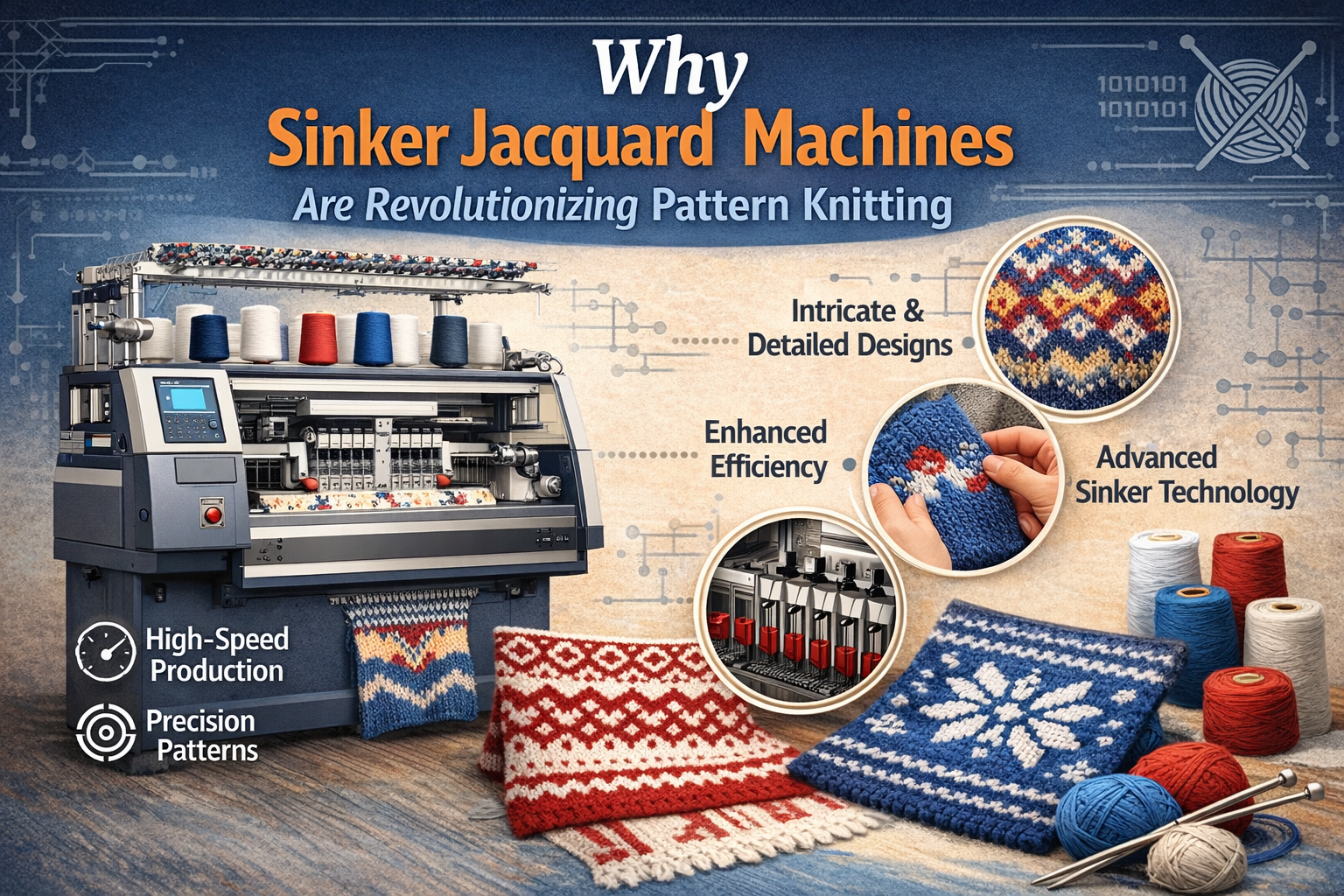
Why Sinker Jacquard Machines Are Revolutionizing Pattern Knitting

Why Sinker Jacquard Machines Are Revolutionizing Pattern Knitting

If you run a textile unit in India, you already know plain fabrics don’t sell the way they used to. Buyers want texture, colour combinations, and designs that stand out. And if you’ve been chasing those results with older cam-driven setups, you’ve probably felt the gap between what your machines can do and what the market demands.

That gap is where sinker jacquard technology steps in. Over the past few years, these systems have quietly changed how manufacturers in Ludhiana, Tiruppur, and Surat approach patterned knit fabrics, and the results speak for themselves.

How a Jacquard Knitting Machine Creates Patterns

A jacquard knitting machine uses individual needle selection to create patterns during the knitting process itself. Each needle can be independently controlled to knit, tuck, or miss a stitch, so you can program anything from simple stripes to complex multi-colour motifs without swapping mechanical parts.

In sinker jacquard systems, the sinker (a thin metal plate between adjacent needles) does more than hold fabric down while needles rise. It actively controls loop formation and stitch tension. When each sinker is electronically controlled, you get stitch-by-stitch precision that fixed-cam systems can’t match. The practical result is sharper colour boundaries, fewer floats, and a noticeably cleaner fabric face.

On a standard machine, sinkers follow a fixed path. They all move the same way at the same time, which is fine for plain single jersey but becomes a bottleneck the moment you need pattern variation within a single course. Electronic sinker selection removes that limitation entirely, and that is why sinker jacquard machines are revolutionizing pattern knitting across the Indian textile industry.

What Makes the Best Electronic Jacquard Worth the Investment

Not all electronic jacquard systems are built the same. Some manufacturers bolt a basic selector onto an older mechanical frame and call it “computerised.” Those machines usually run slower, break down more often, and limit your pattern repeat size.

The best electronic jacquard systems share a few traits. Selection speed keeps up with 25+ RPM. The software reads standard design formats like BMP or PAT files without proprietary conversion. And the hardware handles continuous production without overheating.

When you’re shopping for the best electronic jacquard, look beyond the brochure. Ask about pattern repeat capacity, colour-per-course limits, local spare parts availability, and 24-hour service support. In a market where downtime costs real money, those details matter more than any spec sheet.

Why the Circular Jacquard Knitting Machine Dominates Production

The circular jacquard knitting machine is the workhorse behind most patterned knit fabric produced globally. Running at 28 RPM with 72 feeders, a well-maintained circular jacquard knitting machine produces fabric at speeds flat-bed machines can’t touch. And because fabric comes off as a continuous tube, you skip the selvedge waste that plagues flat knitting.

Single jersey jacquard covers about 70 percent of Indian production needs, ideal for T-shirts, activewear, and innerwear. Double jersey jacquard, using both cylinder and dial, creates thicker reversible fabric for outerwear and technical textiles. That 30 percent of double jersey work is usually the higher-margin business.

Design changes on a computerised circular jacquard knitting machine take minutes instead of hours. Load a pattern file from USB, the machine maps it to needle positions, and you’re running the new design before your chai gets cold. Some systems even preview patterns on-screen so you catch errors before they become 200 metres of wasted fabric.

How a High Speed Electronic Jacquard Machine Pays for Itself

Speed is money in knitting. A high speed electronic jacquard machine uses piezo-electric or spring-return selectors that respond faster than older solenoid systems, maintaining 30+ RPM even on complex multi-colour patterns.

Here are rough numbers: upgrading from a mechanical jacquard at 18 RPM (about 120 kg per shift) to a high speed electronic jacquard machine at 30 RPM can push output to 190 or 200 kg per shift. That is 60 to 70 percent more fabric from the same floor space and the same operator. Factor in faster pattern changes and lower defect rates, and the payback period for most units falls between 18 and 30 months.

Speed does put more stress on parts. Sinkers and needles wear faster, and electronic selectors need periodic inspection. But a solid maintenance routine (daily oiling, weekly sinker checks, monthly electronics review) keeps a high speed electronic jacquard machine running smoothly for years.

Why Sinker Jacquard Machines Are Revolutionizing Pattern Knitting in India

Previous machine upgrades mostly improved speed or reduced labour. Sinker jacquard changes what you can actually make. Patterns that once required expensive imports can now be produced locally. Designs previously limited to slow flat-bed machines can be approximated on fast circular setups.

If you’re considering this upgrade, the machine is only half the equation. You need a supplier who understands the technology well enough to match the right configuration to your products.

That is what Knit N Sew has been doing since 1998. Based in Ludhiana, Knit N Sew supplies new and pre-owned circular knitting machines along with needles, sinkers, spare parts, and hands-on technical support. Whether you need a jacquard knitting machine for the first time or you’re upgrading from an older model, their team can match you with the right equipment. Reach them at (+91) 9814177799 or visit clonit.co.in.

Why Sinker Jacquard Machines Are Revolutionizing Pattern Knitting: FAQs

What is the difference between standard jacquard and sinker jacquard?

Standard jacquard controls only needles electronically while sinkers follow a fixed path. Sinker jacquard controls both needles and sinkers independently, producing sharper designs with fewer defects.

How much does a jacquard knitting machine cost in India?

New electronic models range from INR 15 lakh to INR 50 lakh depending on specs. Pre-owned machines cost less, and Knit N Sew offers both options.

What fabrics can a circular jacquard knitting machine produce?

These machines handle single jersey jacquard, double jersey jacquard, terry jacquard, interlock jacquard, and pique jacquard depending on configuration.

Is the best electronic jacquard worth the premium over mechanical?

For most manufacturers, yes. Faster pattern changes, lower defect rates, and the ability to take on higher-value orders make the best electronic jacquard a strong investment that typically pays back within two years.

How long does it take to operate a high speed electronic jacquard machine?

Experienced circular knitting operators pick up electronic jacquard basics in two to four weeks. Design software takes another week or two. Knit N Sew provides training with machine purchases.

backbone of pattern weaving

Why the Jacquard Machine Is the Backbone of Pattern Weaving

If you’ve ever looked at a patterned fabric and wondered how those precise designs get woven into cloth, the answer almost always traces back to one invention: the Jacquard machine. This technology, originally developed in the early 1800s, didn’t just change weaving. It changed how we think about automated production altogether. And for anyone running a textile unit today, understanding the jacquard knitting machine isn’t optional. It’s the difference between producing basic plain fabrics and creating the high-value patterns buyers actually want.

How the Jacquard machine became the backbone of pattern weaving

Before Joseph Marie Jacquard introduced his punch-card system in 1804, creating patterned fabric was painfully slow. A weaver would manually lift individual warp threads to form each row of a design. Complex patterns could take weeks, errors were common, and scaling up was practically impossible.

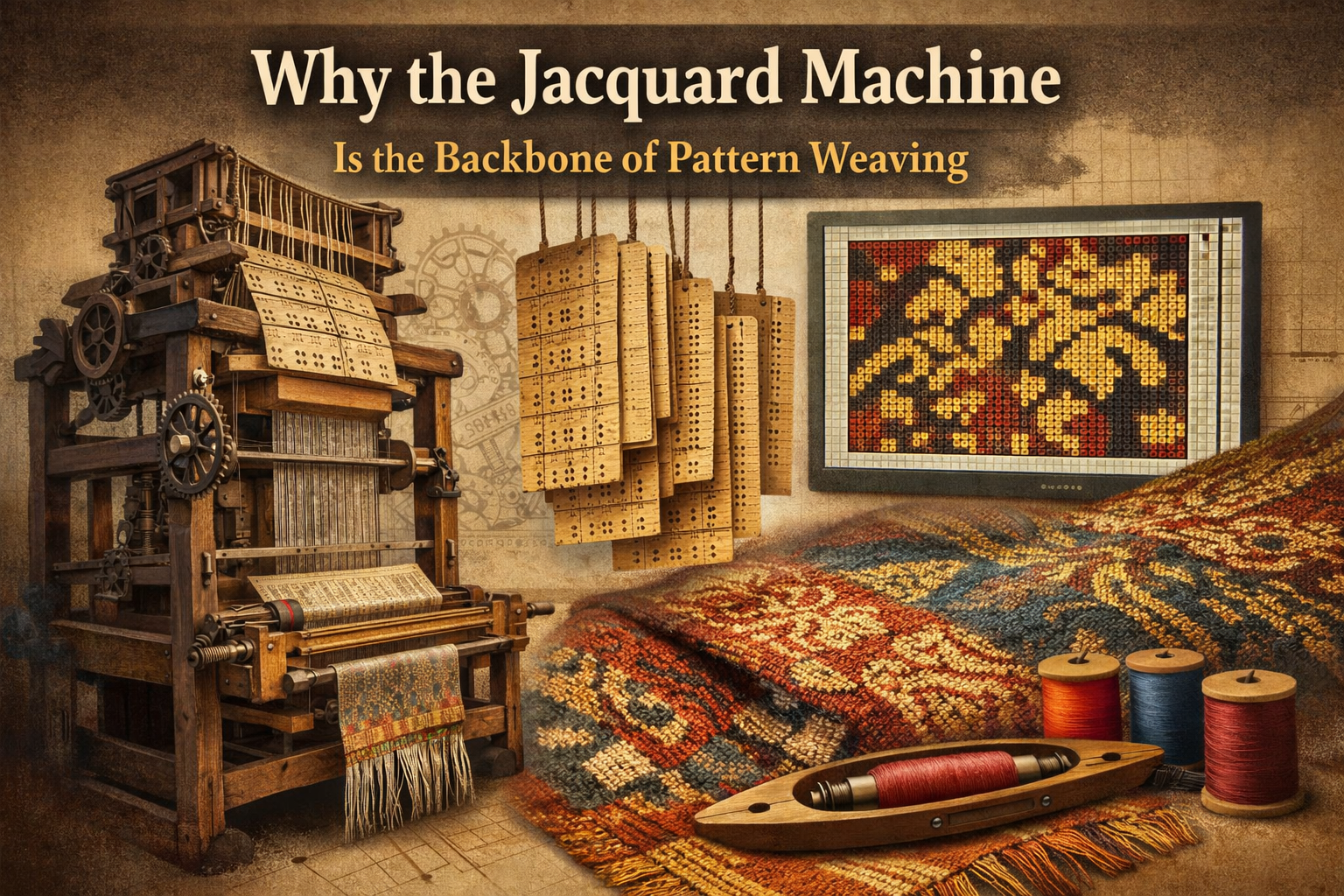
The Jacquard machine replaced that manual thread selection with punched cards. Each card told the loom which threads to raise and lower for a given row. String enough cards together, and you could program an entire pattern without the weaver thinking about individual threads. That was a genuine turning point. The Jacquard machine made patterns that were previously impossible into something any well-equipped workshop could produce.

What a jacquard knitting machine actually does

The principles behind Jacquard’s 1804 invention still run through modern pattern weaving. The technology has evolved from punch cards to electronic controls, but the core idea remains the same. Each needle gets individual instructions about when to engage and when to stay put.

A modern jacquard knitting machine controls each needle independently. Every stitch can be a different color or texture if the design calls for it. Compare that to a standard circular knitting machine, where all needles follow the same pattern repeatedly. The jacquard knitting machine breaks that limitation entirely. This individual needle control is precisely why the Jacquard machine is the backbone of pattern weaving.

Why the Jacquard machine is the backbone of pattern weaving in today’s market

Demand for patterned and customized fabrics has grown sharply. Sportswear brands want unique knit textures. Fashion labels want custom jacquard fabrics. Even home textiles have moved toward detailed patterns on curtains and upholstery. All of this runs on jacquard technology.

The jacquard knitting machine on circular production lines

On a modern electronic jacquard knitting machine, you upload a new design file and the machine reads it. A factory can run three different designs in a single shift without major downtime. Modern jacquard systems control thousands of needles simultaneously while running at high RPM, producing clean, consistent patterns roll after roll. There’s less yarn waste too, because each needle is individually controlled during color changes and transitions. For manufacturers working with expensive yarns like merino blends, the savings add up quickly.

The backbone of pattern weaving: from loom to knitting floor

The term “jacquard” has expanded well beyond its original weaving context. Today, the jacquard knitting machine applies individual needle control to knitted fabrics, not just woven ones. Knitted fabrics have different stretch, drape, and texture characteristics. A jacquard-knitted sportswear fabric can have breathability zones built right into the pattern. The backbone of pattern weaving, then, isn’t confined to one type of production. Jacquard technology has become the common thread running through woven, knitted, and technical textile manufacturing. That’s a big part of Why the Jacquard Machine Is the Backbone of Pattern Weaving, even in factories that primarily run circular setups.

What to look for in a jacquard knitting machine

Choosing the right jacquard knitting machine for your factory

Electronic control has largely replaced mechanical jacquard systems, and for good reason. Electronic offers faster pattern changes and more design complexity. Match your gauge to what your market actually demands, not what looks impressive on a spec sheet. Check compatibility with your existing circular knitting machines before you invest, since some jacquard systems need dedicated frames.

Software matters more than most buyers expect. The best jacquard knitting machine is only as good as the design software feeding it. And don’t underestimate after-sales service. Jacquard systems are more complex than standard machines, so you’ll need a supplier who provides spare parts, troubleshooting, and training.

The backbone of pattern weaving is also the bridge to better margins

Plain fabrics are commodities. Margins stay thin because you’re always competing on price. Patterned and specialty fabrics are a different story. Fewer manufacturers can produce them, so buyers pay more. A jacquard knitting machine lets you move up the value chain without tearing apart your existing operations. We’ve seen manufacturers recoup the cost of their jacquard investment faster than expected, simply because patterned fabrics sell for significantly more per meter.

Partner with Knit N Sew for your jacquard knitting machine needs

Whether you’re upgrading an existing circular knitting line or setting up a new unit from scratch, having the right machinery partner matters. At Knit N Sew, we’ve been supplying textile manufacturers in Ludhiana and across India with circular knitting machines, needles, and spare parts since 1998. Our team understands the practical demands of a knitting floor, and we work closely with our clients to match them with the right equipment for their production needs and budget. Reach out to us at clonit.co.in or call us directly to request a quote.

FAQs

What is a jacquard knitting machine?

A jacquard knitting machine controls each needle independently, allowing it to produce complex, multi-color patterns in fabric. It applies the same principles Jacquard introduced for weaving looms in 1804, adapted for modern knitting production.

How is a jacquard knitting machine different from a regular knitting machine?

A regular knitting machine moves all needles in the same pattern repeat. A jacquard knitting machine controls each needle separately, so every stitch in the fabric can be different.

Why is the Jacquard machine called the backbone of pattern weaving?

The Jacquard machine introduced individually controlling threads and needles using programmed instructions. This concept remains the foundation of all patterned fabric production today, whether woven or knitted.

Can a jacquard knitting machine work with circular knitting setups?

Yes. Jacquard systems are available as attachments for circular knitting machines or as dedicated jacquard circular machines that combine high-speed tubular production with pattern control.

Where can we get reliable jacquard and circular knitting machines in India?

Knit N Sew, based in Ludhiana, offers circular knitting machines, spare parts, needles, and technical support for textile manufacturers. Visit clonit.co.in to learn more or request a quote.

Why Every Textile Factory Needs an Advanced Textile Knitting Machine Today

Why Every Textile Factory Needs an Advanced Textile Knitting Machine Today

Most textile factory owners we’ve spoken to in Ludhiana say the same thing: machines that worked fine five years ago are now costing them money. Not because they broke down, but because they can’t keep up. Orders are tighter, margins thinner, and buyers who once gave two weeks now want delivery in five days.

If your production floor still runs on older equipment, you’re not just behind schedule. You’re behind the market.

Why every textile factory needs an advanced textile knitting machine today

Fabric buyers want smaller batches, faster turnarounds, and consistent quality across every roll. A textile knitting machine built for 2015 volumes simply cannot handle 2026 demands without creating bottlenecks.

Fast fashion cycles have shortened from months to weeks. Export clients run third-party audits that flag even small variations in GSM or loop density. Your workforce has shrunk because skilled operators are hard to find. An advanced knitting machine absorbs that pressure by automating tasks that used to depend entirely on a senior operator’s instinct and eye.

How does a modern textile knitting machine change daily output?

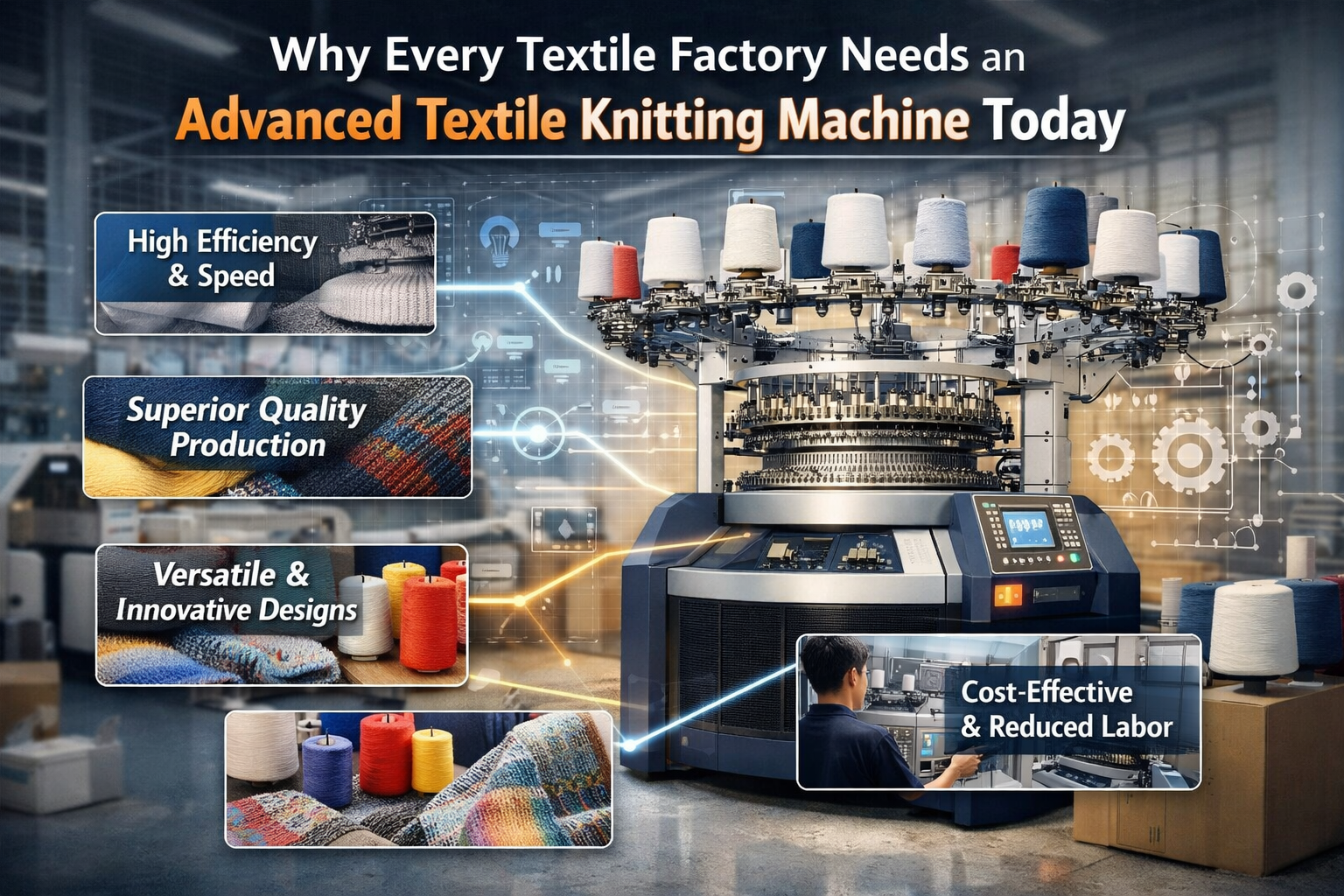
A modern circular textile knitting machine running at 25 to 30 RPM with 90+ feeders produces 350 to 500 kg of single jersey fabric per day. Older models manage 180 to 250 kg. That is double the output from the same floor space and operator count.

But speed is only part of the story. With older equipment, you lose 8 to 12 percent of production to defects like dropped stitches, oil stains, and uneven tension. A well-maintained advanced knitting machine brings rejection down to 2 or 3 percent. Over a month, that difference alone pays for the upgrade.

How does needle precision affect fabric quality in a textile knitting machine?

Older machines use standard latch needles that wear unevenly. After a few months, certain cylinder sections produce tighter loops than others, showing up as horizontal lines or shade variation after dyeing.

Modern machines use precision-ground needles with tighter tolerances. Some models let you swap needle types without retiming the entire machine, so you can switch between cotton, polyester, and blended yarns within the same shift. For a textile factory handling multiple fabric types, this flexibility removes hours of changeover time.

Energy savings: what it actually costs to run a knitting machine

An older 30-inch circular knitting machine consumes 5 to 7 kW per hour. A newer model of similar diameter uses 3.5 to 5 kW at higher RPM. Multiply that gap by 8,000 running hours a year, and you’re looking at savings of Rs 2 to 4 lakhs annually, depending on your state electricity tariff.

For textile factory operators in Punjab and Tamil Nadu, where power costs have risen 15 to 20 percent in three years, this is a real number that affects annual margins.

What to look for when buying a textile knitting machine?

Gauge and diameter: matching the knitting machine to your fabric type

A 24-gauge machine handles fine fabrics for T-shirts and innerwear. A 14 or 18-gauge suits thicker rib or interlock fabrics. Diameter affects roll width: 30-inch is standard for garment panels, while 34 or 36-inch works better for bedsheet fabrics. Get it wrong, and you waste material or lose orders.

Spare parts and service: the hidden cost of the wrong knitting machine

A machine is only as reliable as the supply chain behind it. If your knitting machine uses proprietary needles that take three weeks to import, every breakdown becomes a production crisis. Machines from manufacturers with local dealer networks in Ludhiana give you needles, sinkers, and cams within a day or two. That is the difference between a one-shift disruption and a week-long shutdown.

The real cost of outdated equipment in a textile factory

If you’re losing 10 percent of production to quality issues and your monthly output is worth Rs 25 lakhs, that is Rs 2.5 lakhs in wasted fabric every month. Over a year, it crosses Rs 30 lakhs.

Delivery delays cost clients. Export buyers penalize late shipments, and some cancel outright. Miss two or three deadlines, and that client goes to your competitor next season.

Labour cost is another factor nobody tracks properly. Older machines need experienced operators who manually adjust tension and catch defects by sight. Newer machines with automatic tension control let less experienced operators run two machines at once with fewer errors. Your per-machine labour cost drops almost in half.

Add it all up, and most textile factory owners find their “fully paid off” old machine costs them Rs 40 to 60 lakhs a year in hidden losses.

Choosing between new and used textile knitting machines

Budget matters. Not every operation can invest Rs 15 to 25 lakhs upfront. Used knitting machines from a reliable dealer can deliver 70 to 80 percent of new machine performance at 40 to 50 percent of the cost.

What matters is who you’re buying from. A good dealer will have already replaced or reground the needles, recalibrated the yarn feeders, and run the machine under load before showing it to you. Ask about the motor condition and whether they offer at least 3 to 6 months of warranty on parts. If they hesitate on any of that, you’re better off looking elsewhere.

FAQs

What types of fabric can a textile knitting machine produce?

Single jersey, rib, interlock, pique, fleece, terry, and mesh fabrics. The specific output depends on gauge, cam arrangement, and feeder setup.

How often does a knitting machine need maintenance?

Daily cleaning and oiling are necessary. Full service, including needle replacement and cam inspection, should happen every 3 to 6 months based on running hours.

Can a small textile factory benefit from an advanced knitting machine?

A two or three-machine setup with modern equipment can outperform a larger unit running five or six older machines, thanks to higher output per hour and lower fabric wastage.

Get in touch with Knit N Sew Enterprises

If your current equipment is holding your textile factory back, talk to the team at Knit N Sew Enterprises. They’ve been operating out of Ludhiana since 1998, so they know the local market and the kind of machines that actually hold up on Indian production floors. They deal in new and used circular knitting machines, stock needles and sinkers, and carry spare parts for the most common models. More importantly, they can tell you what your factory actually needs instead of just selling you the most expensive option.

Call Now Button